
Dic. 4, 2018
di Francesca Giavelli e Viviana Ingrassia.
MiCo – On Tuesday, November 13, Mathieu Roche closed our first day at IABforum with a workshop dedicated to the “The impact of Cookie Matching on publisher websites”.
Roche is the Cofounder & CEO of ID5, an identification service provider, which enables user identification online. Anyone who operates, buys ads, serves ads, talks at users in a programmatic environment, i.e. vendors, agencies, brands and publishers, can benefit from its user identification capabilities. In particular, ID5 is the first centralized Cookie Matching platform for the ad-tech industry. The focus of Roche’s workshop was concentrated on the publishers’ side of the business.
As a video explained, most websites rely on ads to provide free content and services to their users. With the development of programmatic, publishers’ inventories and audiences are monitored by platforms, and since these platforms work from different web domains – they use different “languages” – they have to match cookies with each other to operate; therefore online publisher will have to accept Cookie Matching. With the increasing complexity of the ecosystem – the number of platforms is exponentially increased – the system has become unbearable: Cookie Matching increases page latency by an average of 12 seconds. It also creates risks of data leakage by giving access to the page to unknown vendors. Such activity being considered as collection of personal data, publishers are responsible for the process under the GDPR. Cookie Matching results therefore in three major concerns to publishers.
First, making sure that advertising does not get in the way of the users’ experience, by keeping a low page latency – pages load fast – and by using non-intrusive formats. Cookie Matching is indeed a process that slows down websites: for different platforms to match user IDs, they need to fire pixels. ID5 has screened 30 Italian websites and discovered there are an average of 30 different pixels being fired per page. Those pixels take up to 5 seconds to load, and this makes pages 5 seconds slower to load, which creates a massive impact on users’ experience. Moreover, the latency depends also on the size of the pixel being fired – a relevant detail for mobile-users in particular – and on how long the pixel takes to respond: some are very light and fast, others are heavier and slower to load. This goes through an average of 500 ad-tech platforms. Today, everyone is trying to match with everyone else, so the same pixel is triggered more than 20 times per page. «It’s the way it’s been designed but it doesn’t work anymore: programmatic has become mainstream, the main way to transact ads online and it requires Cookie Matching. And Cookie Matching doesn’t work when you have 500 ad-tech platforms operating on your site» says Roche commenting on the present highly inefficient system and on what pushed him to create a new centralized way to synchronize IDs.
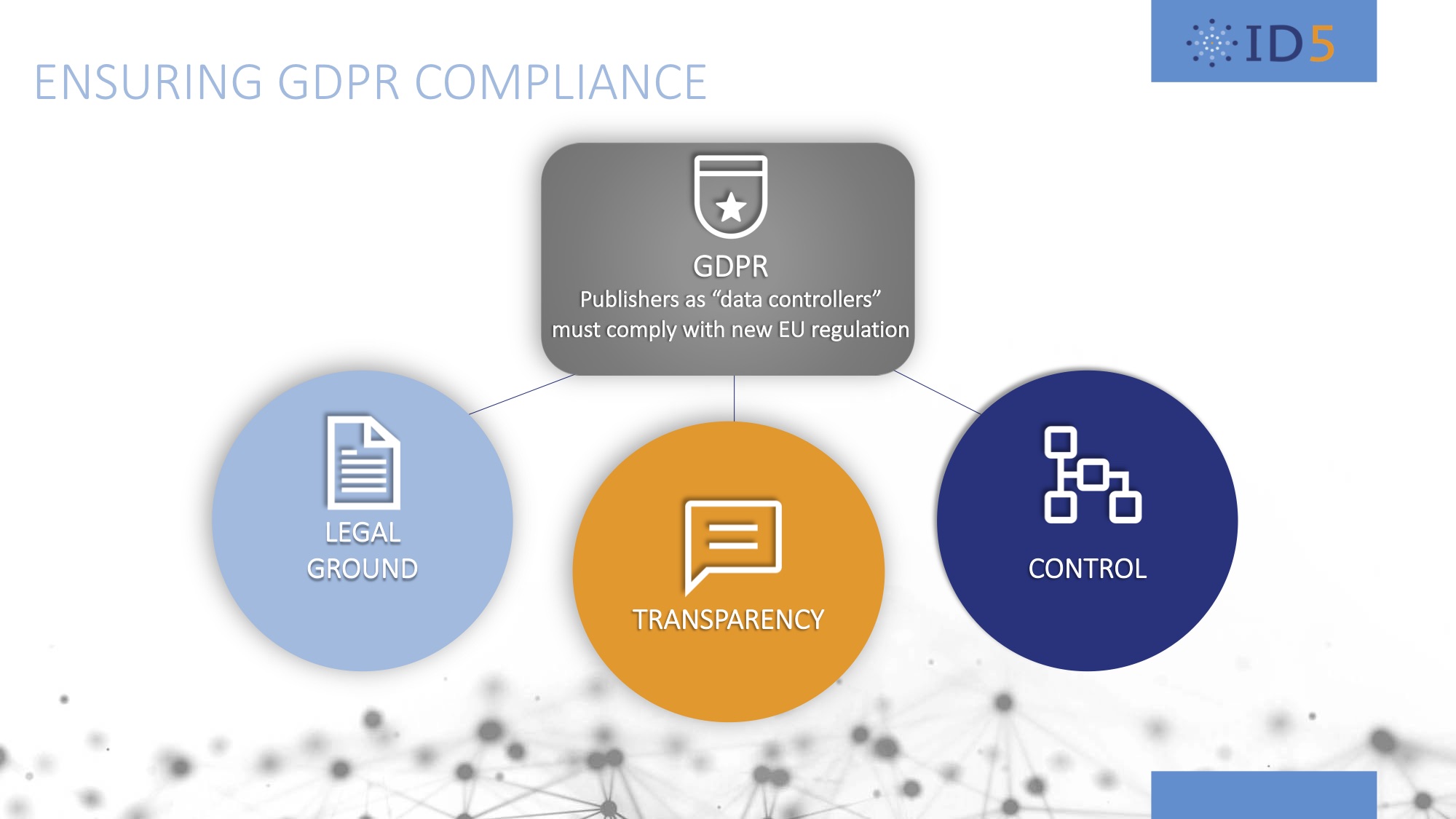
Second, privacy and GDPR compliance, since today Cookie Matching is not GDPR compliant. As a matter of fact, according to the General Data Protection Regulation, publishers are data-controllers and responsible towards users to have legal basis to collect and process their data, to be transparent about the process, to give them some level of control over the processing operation, to tell them there are plenty of vendors who have access to the page and therefore to their user IDs; up till now, publishers were not able to control this last step. «It’s only users’ IDs, it’s not super sensible information» explains Roche «we’re talking to Data Protection Agencies across Europe, they know but this…, it’s not their priority, but it is a breach of GDPR compliance.» Now, ID5 has created a way to gain control of this process in terms of privacy, too.
Last but not least, maximizing advertising revenues. When you issue a bid request for someone to buy it, the system sends the bid request to buyers. Since they do not speak the same language, they need a match table that matches users’ IDs, «that says the user that I know as being “123” is actually called “456” for this guy, “789” for this other, “ABC” for this other guy, etc. etc. everyone has a different language.» is Roche’s basic explanation. The match-rates for IDs are not perfect, 60-75%, meaning that for every impression not all the user IDs are matched: buyers do not know who the user is and they cannot bid. Therefore, improving match-rates, i.e. having a better match table with more matches, implies that more buyers are in competition bidding on the impression, that there is a higher bid-density and therefore a higher bid-closing price: overall it improves the revenues.
With this dense but clarifying overview, Roche introduces his platform ID5 as a means to address the issue without damaging advertising revenues. ID5 is the first centralized Cookie Matching platform for the ad-tech industry, which matches cookie-IDs between platforms, making it possible for them to share information with each other in an efficient and centralized way. Publishers regain control over the Cookie Matching process: they can manage page latency, decide which platforms are allowed to match cookies on their pages and respect users preferences when it comes to personal data collection. Ad-tech platforms also benefit from ID5 services in saving matching costs, eliminate ramp-up time and improve match-rates with each others. ID5 is «an efficient transparent and privacy-compliant Cookie Matching service.»


