
This speech was dedicated to the rebuilding digital marketing without cookies and held by Alexia Nakad, Managing Director, LiveRamp and Matteo Nisi, Chief Data Officer, Dentsu Aegis. It was particularly useful for making marketers understand how to utilise first-party data for more effective reach, increased ROI and media efficiencies through people-based activation and measurement.
Such an important issue as a broken consumer trust was the starting point for a discussion. According to Alexia Nakad, the industry broke consumer trust in a way that it wasn’t transparent how the data was collected and utilized across the ecosystem. As a result of that we see some regulations like GDPR, CCPA, which intended to enhance privacy rights and consumer protection. We saw changes upon Safari, Firefox that moved the third party cookies and can currently see some cookies disappearing on Google Chrome.
2020 has been a very tough year for everyone. Because of lockdowns across the Globe consumers aren’t able to go to stores, so brands have to shift the way they communicate with clients. That’s why brands should change their digital strategy and increase the renovation when it comes to digital transformation in terms of connecting with consumers online.
We see a big movement away from traditional media on marketing spend. E.g., WARC and eMarkter 2020 to 2021 estimates that cinema ad spend is getting lower (-31%), the same trend we see with print ad spend (-41%), ecc. In the same time there is a notable increase in the digital channels when it comes to ad spend, web based and mobile ad spend.
So, we’ve got a world where cookies and digital identity are disappearing and we have a world where digital acceleration is becoming more and more important.
What does it mean for marketers?
First of all, they must demonstrate their value, which is more important than ever to execute on key marketing capabilities and do them well. Another important steps might be:
- Audience Activation and Retargeting;
- Frequency Capping and Suppression;
- Media Measurement and Attribution;
- Audience Insights and Segmentation;
- Site Personalization.
And here we go with some practical solutions from Matteo Nisi for surviving in the post cookie era. How could the scenario change with the revolution of cookies? What can we do without cookies?
Imagining a digital world without cookies sounds incredible since with cookies we can track, measure, segment, clustering. So, basically nowadays everything is cookie based. The question is there a method to substitute cookies?
Basically, we can distinguish 3 families of solutions:
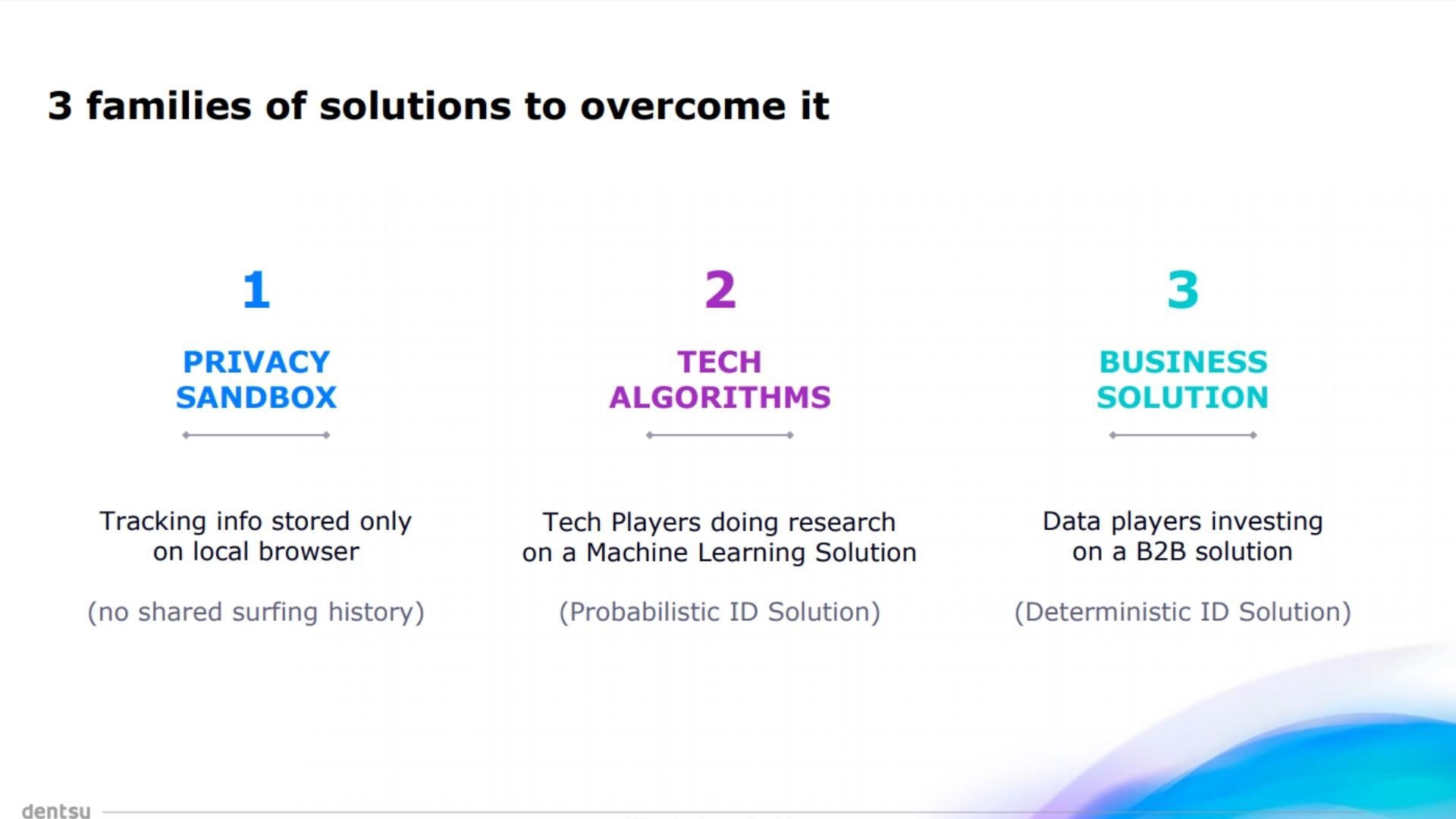
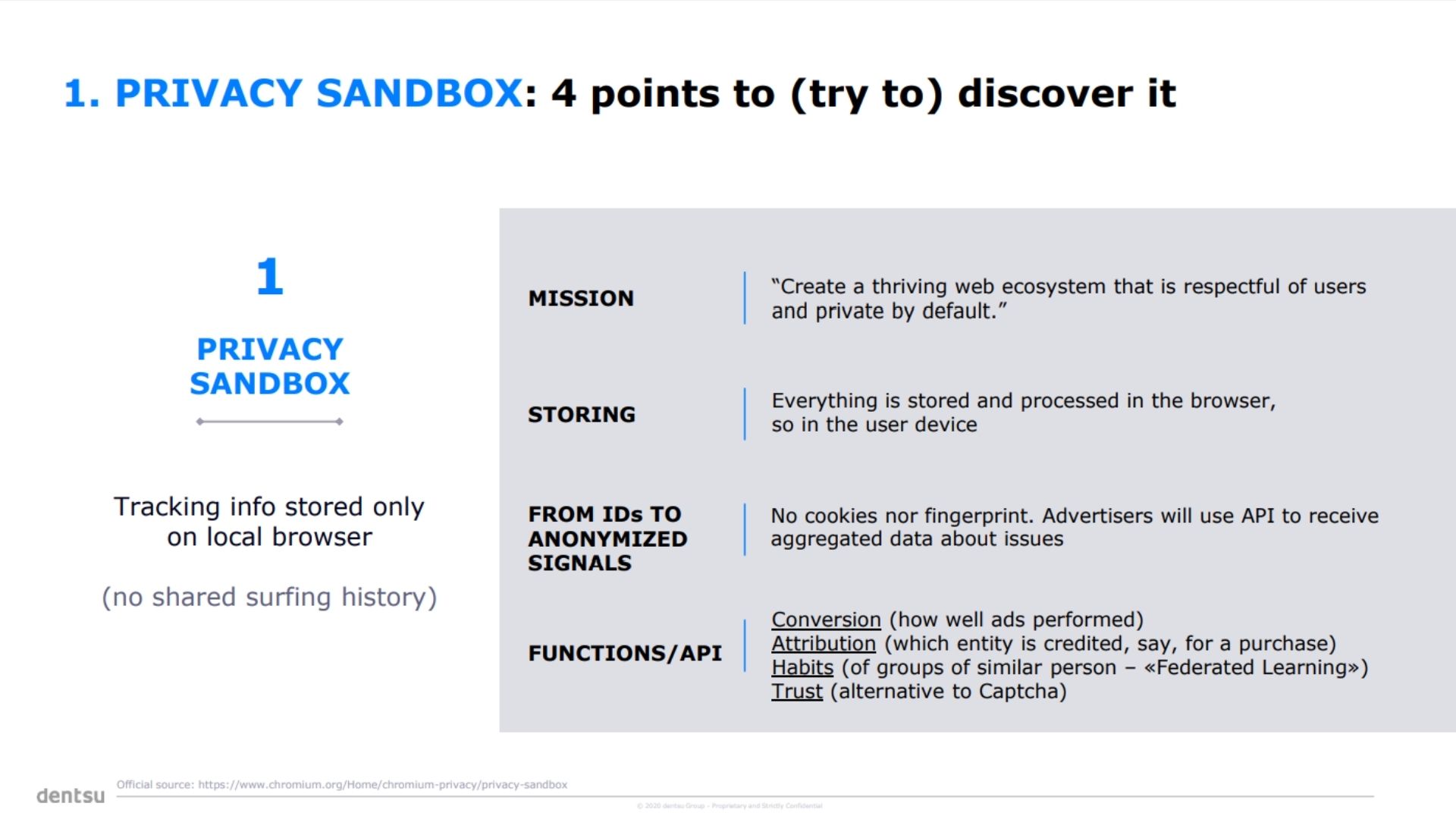
The first family is called Privacy sandbox. Google announced that even when cookies disappear we will be able to do the same things as we did before. A special tool on a local browser will help us to understand if we are dealing with a real browser or it is a bot; measure the ad performance, attribution and even habits (“Federated Learning”). We won’t need any cookies storing the data from the browser, in the user device.
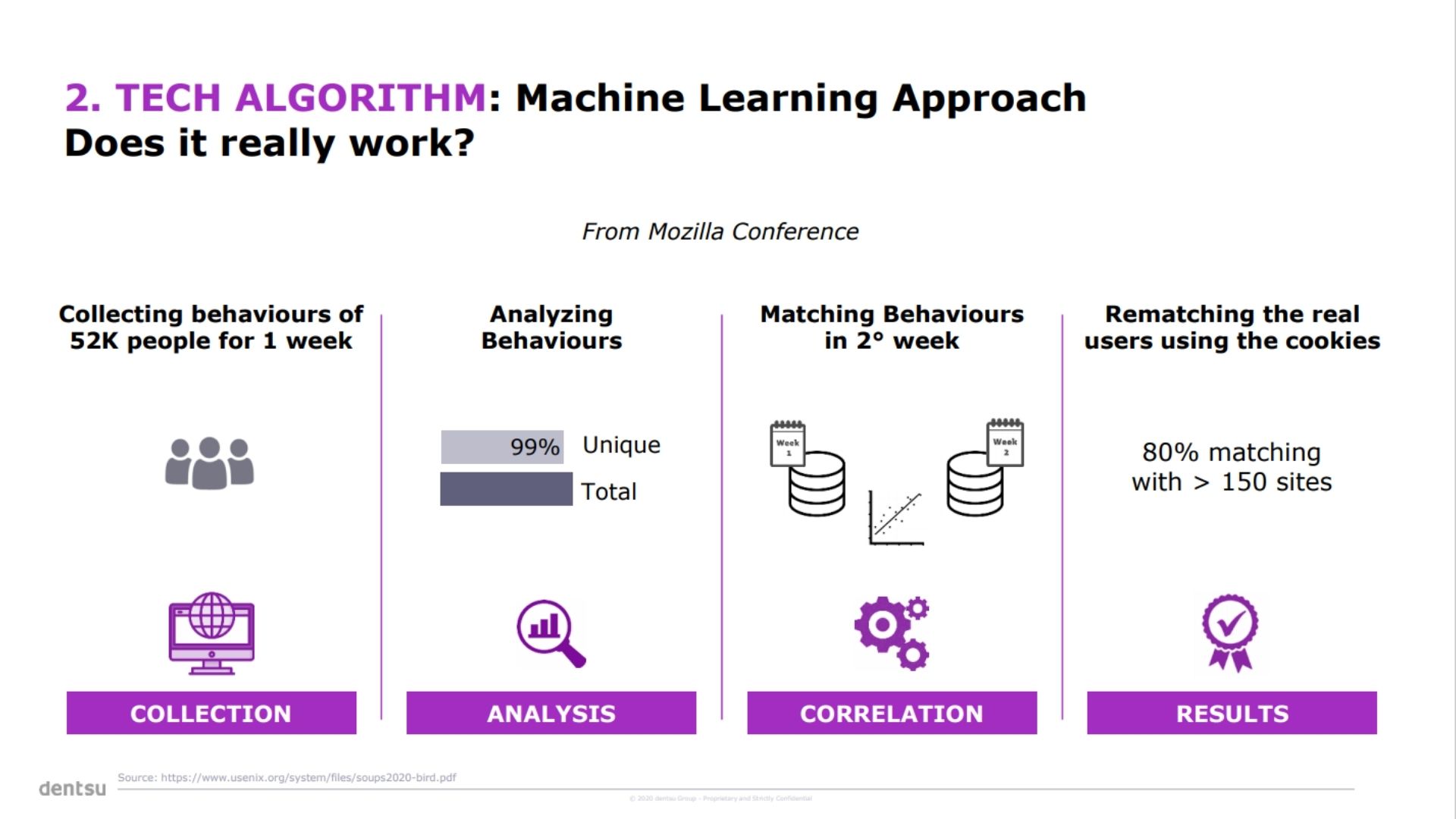
Also we might consider the so-called Tech Algorithm. In order to create an ID, computers will use machine learning. Is it even possible? In the chart below we can find a very recent academic research and see some important data about the efficiency of machine learning approach. Researchers analysed the behaviour of 52K users of Mozilla Firefox during one week.
The third category is called Business solution, which we can divide into two parts:
- Syndicate coalition: a promising but harder way to implement a solution. Publishers meta-agreement in order to share common information, but it’s quite hard to implement (tech and volumes difficulties).
- Real deterministic approach: tech players and publishers investing on a B2B solution, when every step is legally compliant with GDPR regulation.
LiveRamp adds another solution which they call Authenticated Traffic Solution (ATS). The goal of ATS is to establish scaled identity without third-party cookies through trusted and transparent first-party authentications individuals have with brands and publishers.
As key benefits сan be distinguished:
- Provides individuals with clear notice and choice on how their data is being used;
- Gives individuals a persistent, people-based opt out;
- Delivers enhanced data security for brands and publishers;
- Supported on all owned and operated digital properties.
There are also four ways to tackle the cookieless scenario:
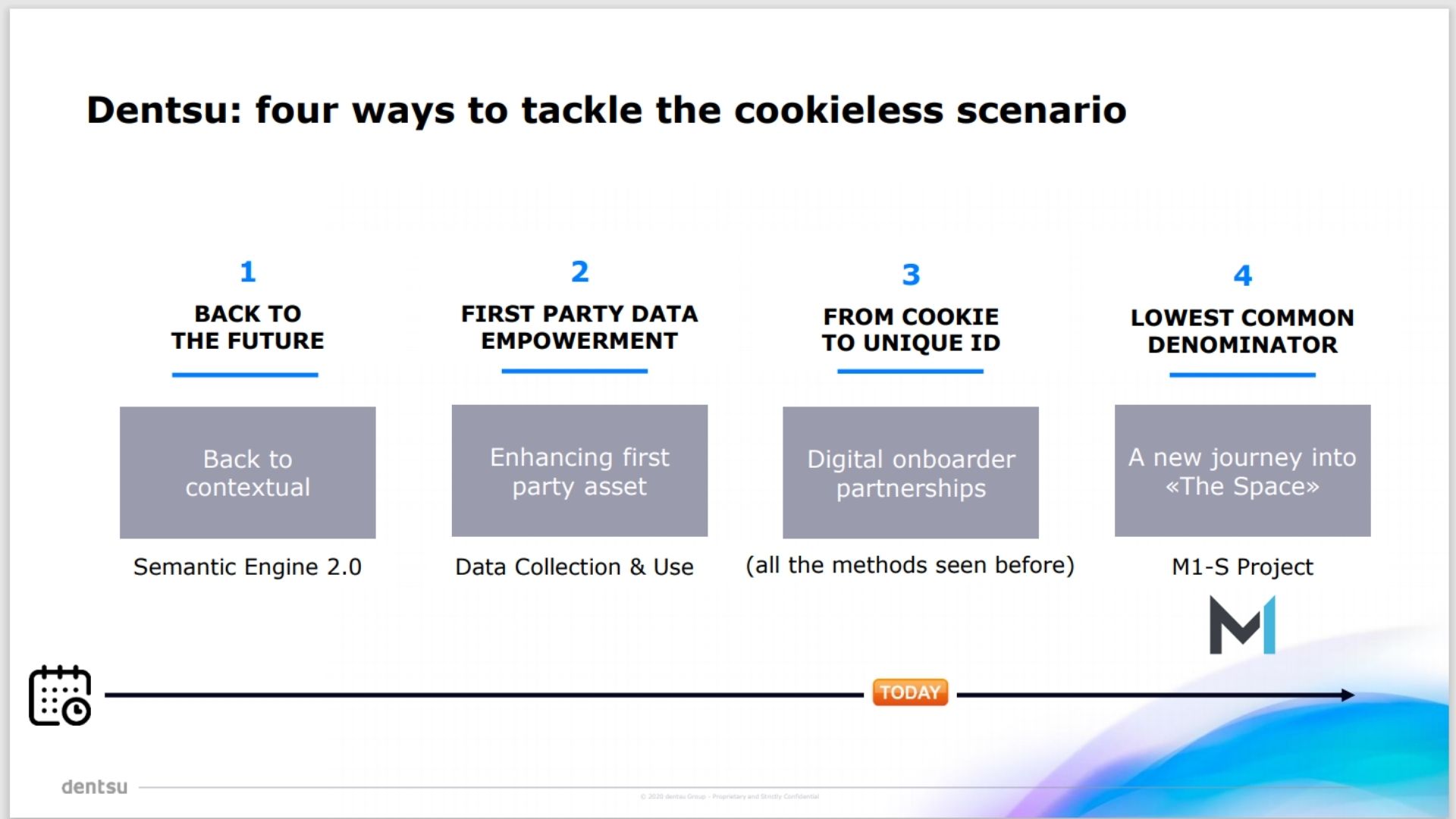
To be more precise we might consider 4 steps to be evaluated, to start quickly with a cookieless test:
- Collection: a more direct relation with customers have also the good side effect to extend the first party data collection;
- Identity resolution: % of unique ID sync from CRM: how many customers can be digitalized?
- Activation and enrichment: through DSP (or injected back into DMP to activate a CRM campaign);
- Trust transparency and legal readiness: easy procedure to exchange data with GDPR compliance.
“Brave new world” for marketers in the XXI century is a world without cookies! But with many new tools to run marketing capabilities such as audience activation and retargeting, frequency capping and suppression, site personalization, media attribution and more use cases without third-party cookies.


